What Is Going Viral in Online weather news? 18 Stories From the Past Days and Months
What are Americans reading and sharing right now? This guide to viral online weather news stories gathers real headlines from news outlets, credits every source by name, and explains how to read each one with a clear head. It is a starting point, not a replacement for the original reporting.
Every item below points to a real report from a named outlet. The commentary around each headline is general context about how news spreads and how to read it, not new reporting. If a story matters to you, follow the link and read it in full before you share it.
Where These Headlines Come From
Headlines in this roundup come from public news feeds covering a wide range of outlets. Duplicates are removed, each item keeps its source name and publication date, and every headline is linked to the original article so nothing here depends on trust in this page alone.
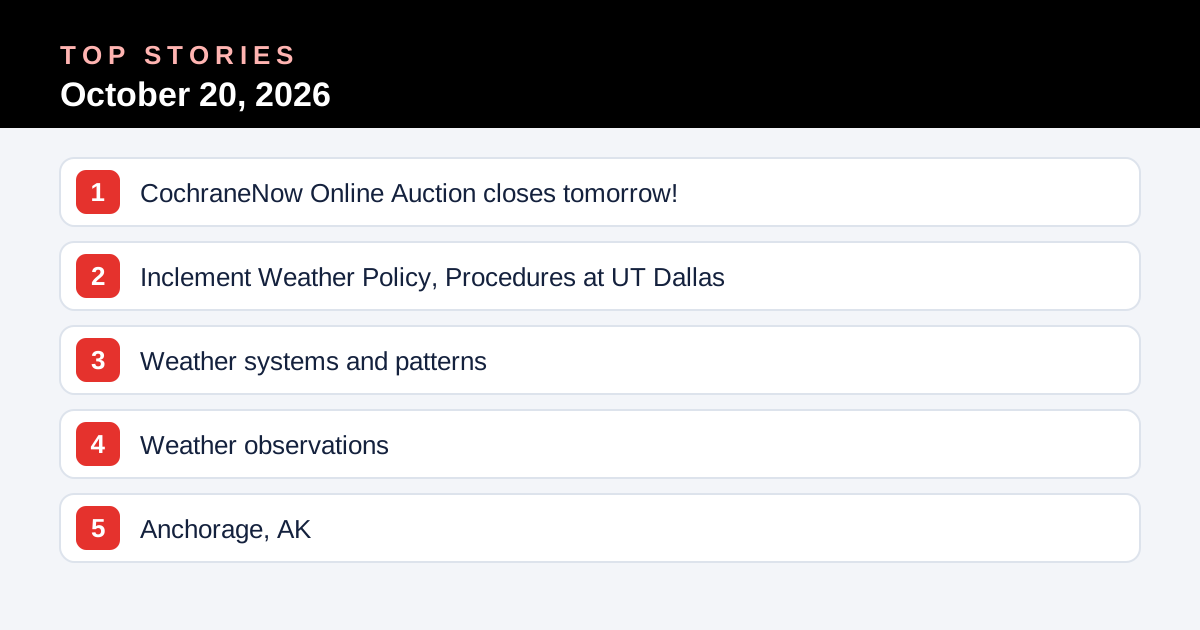
CochraneNow Online Auction closes tomorrow!
CochraneNow ran this item on Oct 20, 2026 with the headline "CochraneNow Online Auction closes tomorrow!". Short headlines are built to be understood at a glance, which is why they travel so well on social media. Readers who want details should follow the link, because this summary does not replace the original reporting.
Source: CochraneNow, Oct 20, 2026
Inclement Weather Policy, Procedures at UT Dallas
The University of Texas at Dallas reported this story on Oct 1, 2026 under the headline "Inclement Weather Policy, Procedures at UT Dallas". Short headlines are built to be understood at a glance, which is why they travel so well on social media. If the story matters to you, compare it with a second outlet to see whether the main points match. This is one of the stories people have been talking about, and the source link below leads to the full report.
Source: The University of Texas at Dallas, Oct 1, 2026
Weather systems and patterns
The headline "Weather systems and patterns" appeared on Aug 25, 2026 from National Oceanic and Atmospheric Administration (.gov). Stories that touch everyday life tend to be passed along fast, even when only a few details are known. If the story matters to you, compare it with a second outlet to see whether the main points match. The full article is the place to find names, numbers, and quotes, none of which are repeated here.
Source: National Oceanic and Atmospheric Administration (.gov), Aug 25, 2026
Weather observations
National Oceanic and Atmospheric Administration (.gov) ran this item on Aug 19, 2026 with the headline "Weather observations". Interest in a story often grows when several outlets cover it at once, which makes it feel bigger than any single report. Checking the publication date matters, because older stories sometimes resurface and look new. The full article is the place to find names, numbers, and quotes, none of which are repeated here.
Source: National Oceanic and Atmospheric Administration (.gov), Aug 19, 2026
Anchorage, AK
National Weather Service (.gov) reported this story on Sep 4, 2016 under the headline "Anchorage, AK". Short headlines are built to be understood at a glance, which is why they travel so well on social media. A good habit is to read past the first paragraph and look for named sources and clear dates.
Source: National Weather Service (.gov), Sep 4, 2016
Reid Kisselback — Spectrum News Meteorologist
Spectrum News ran this item on Mar 5, 2026 with the headline "Reid Kisselback — Spectrum News Meteorologist". Stories that touch everyday life tend to be passed along fast, even when only a few details are known. Before sharing, it helps to open the linked report and check who wrote it and when it was published. The full article is the place to find names, numbers, and quotes, none of which are repeated here.
Source: Spectrum News, Mar 5, 2026
Overnight Weather Forecast | 10-19-26
ABC10 ran this item on Oct 20, 2026 with the headline "Overnight Weather Forecast | 10-19-26". When a story trends, the first version many people see is a screenshot of the headline rather than the article itself. A good habit is to read past the first paragraph and look for named sources and clear dates.
Source: ABC10, Oct 20, 2026
Weather Video
The headline "Weather Video" appeared on Nov 3, 2025 from News 9. Short headlines are built to be understood at a glance, which is why they travel so well on social media. Checking the publication date matters, because older stories sometimes resurface and look new.
Source: News 9, Nov 3, 2025
Super Typhoon Bavi reaches 'gargantuan' size as it barrels toward Taiwan and China
On Jul 9, 2026, FOX Weather published a report headlined "Super Typhoon Bavi reaches 'gargantuan' size as it barrels toward Taiwan and China". Stories that touch everyday life tend to be passed along fast, even when only a few details are known. Before sharing, it helps to open the linked report and check who wrote it and when it was published.
Source: FOX Weather, Jul 9, 2026
French police probe suspected weather device tampering after odd Polymarket bet
On Apr 23, 2026, NPR published a report headlined "French police probe suspected weather device tampering after odd Polymarket bet". A headline can only hold a fraction of a story, so the full report usually contains context that a headline leaves out. Readers who want details should follow the link, because this summary does not replace the original reporting. The full article is the place to find names, numbers, and quotes, none of which are repeated here.
Source: NPR, Apr 23, 2026
Was San Antonio fooled by 'false fall'? Temps could flirt with 90 again.
San Antonio Express-News ran this item on Oct 20, 2026 with the headline "Was San Antonio fooled by 'false fall'? Temps could flirt with 90 again.". When a story trends, the first version many people see is a screenshot of the headline rather than the article itself. Checking the publication date matters, because older stories sometimes resurface and look new. This is one of the stories people have been talking about, and the source link below leads to the full report.
Source: San Antonio Express-News, Oct 20, 2026
Storm spotter information for the National Weather Service Forecast Office - Omaha, NE
Under the headline "Storm spotter information for the National Weather Service Forecast Office - Omaha, NE", National Weather Service (.gov) covered this story on Apr 28, 2017. Interest in a story often grows when several outlets cover it at once, which makes it feel bigger than any single report. Checking the publication date matters, because older stories sometimes resurface and look new. The full article is the place to find names, numbers, and quotes, none of which are repeated here.
Source: National Weather Service (.gov), Apr 28, 2017
WFO Anchorage Area Observations
National Weather Service (.gov) ran this item on Sep 3, 2016 with the headline "WFO Anchorage Area Observations". When a story trends, the first version many people see is a screenshot of the headline rather than the article itself. Readers who want details should follow the link, because this summary does not replace the original reporting. The full article is the place to find names, numbers, and quotes, none of which are repeated here.
Source: National Weather Service (.gov), Sep 3, 2016
Pleasant fall weather continues throughout the week
Under the headline "Pleasant fall weather continues throughout the week", Detroit Lakes Tribune covered this story on Oct 19, 2026. Short headlines are built to be understood at a glance, which is why they travel so well on social media. Updates are common as new information arrives, so the original page may now say more than the headline did. We include it here because it was widely reported, not because we have verified every detail.
Source: Detroit Lakes Tribune, Oct 19, 2026
1 to 2 Inches of New Snow Expected During Thursday's Evening Commute in the Anchorage Bowl and Mat-Su Valleys
National Weather Service (.gov) ran this item on Mar 4, 2018 with the headline "1 to 2 Inches of New Snow Expected During Thursday's Evening Commute in the Anchorage Bowl and Mat-Su Valleys". Headlines like this spread quickly because readers often share them before opening the full article. If the story matters to you, compare it with a second outlet to see whether the main points match.
Source: National Weather Service (.gov), Mar 4, 2018
Forecasts
ECMWF ran this item on May 22, 2014 with the headline "Forecasts". Short headlines are built to be understood at a glance, which is why they travel so well on social media. If the story matters to you, compare it with a second outlet to see whether the main points match.
Source: ECMWF, May 22, 2014
Hurricane and Tropical Cyclones
On Mar 11, 2016, Weather Underground published a report headlined "Hurricane and Tropical Cyclones". Stories that touch everyday life tend to be passed along fast, even when only a few details are known. Before sharing, it helps to open the linked report and check who wrote it and when it was published. The full article is the place to find names, numbers, and quotes, none of which are repeated here.
Source: Weather Underground, Mar 11, 2016
RCMP warns businesses about disruptive cyberattacks
The headline "RCMP warns businesses about disruptive cyberattacks" appeared on Oct 20, 2026 from DiscoverAirdrie. Short headlines are built to be understood at a glance, which is why they travel so well on social media. Readers who want details should follow the link, because this summary does not replace the original reporting.
Source: DiscoverAirdrie, Oct 20, 2026
Spotting Misleading Images and Clips
Photos and short videos spread faster than text, and they are also easy to reuse out of context. An image that appears to show a current event may be older, from another place, or edited. Reverse image search tools and the original publisher's page can help confirm where a picture came from. If a striking image has no clear source, treat it with caution until a reliable outlet confirms it.
How Publishing Times Affect What You See
The United States spans several time zones, so a story posted in the morning on the East Coast may reach the West Coast before anyone there has woken up. Outlets also schedule articles around peak reading hours, and platforms show posts at different moments to different people. As a result, two readers can see the same story at very different points in its life. Checking the publication date and time on the original page helps you understand how current a report really is.
Why Some News Stories Go Viral
News goes viral when it is easy to understand, easy to share, and connected to something people already care about. Strong emotions such as surprise, worry, or pride make readers more likely to pass a story along. Timing matters too: a story that lands during a busy news day may be overlooked, while the same story on a quiet day can dominate every feed. None of this says whether a story is accurate, which is why careful readers separate how popular a headline is from how reliable its details are.
Opinion Pieces Versus News Reports
News reports aim to describe what happened, while opinion pieces argue for a point of view. Both can be valuable, but they should not be mixed up. Reputable outlets label opinion and analysis clearly. When a headline sounds more like a verdict than a description, check whether the article is an opinion column before treating its claims as settled facts.
The Bottom Line on Today's Viral Online weather news Stories
These stories are a snapshot of what has been widely reported. Because details change, the linked articles are the best place for accurate and current information. Check back for new roundups as other stories rise through the news. Read the source. Slow reading beats fast sharing.
This roundup is compiled automatically from the linked news reports. Details may be incomplete or change; please read the original sources.