Viral Social media news Stories Right Now: 12 Headlines Americans Are Reading
Viral social media news stories rarely stay in one place. A single headline can move from a local website to national television and then to millions of screens within hours. Below is a roundup of recent headlines from across the USA, each linked to the original report so you can read the full story yourself.
A note on how this page works: the headlines and outlet names below come directly from public news feeds. We do not add details that the reports do not state, and we do not claim to know more than the original journalists. When you want facts, names, numbers, or quotes, open the linked report.

How These Stories Were Chosen
The stories below were found through public news feeds that list headlines from many outlets. We look for recent reports that match the topic, skip repeats of the same story, and keep the outlet name and date next to each headline so you can judge the source for yourself.
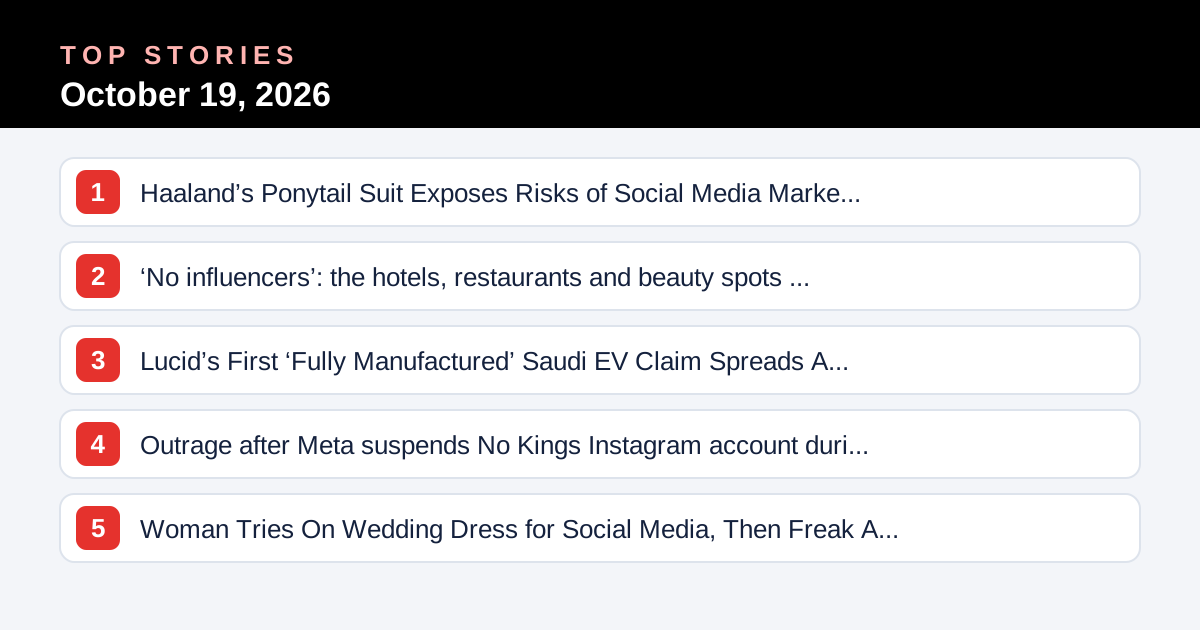
Haaland’s Ponytail Suit Exposes Risks of Social Media Marketing
The headline "Haaland’s Ponytail Suit Exposes Risks of Social Media Marketing" appeared on Oct 19, 2026 from Bloomberg Law News. Short headlines are built to be understood at a glance, which is why they travel so well on social media. If the story matters to you, compare it with a second outlet to see whether the main points match. We include it here because it was widely reported, not because we have verified every detail.
Source: Bloomberg Law News, Oct 19, 2026
‘No influencers’: the hotels, restaurants and beauty spots restricting photoshoots
The Guardian ran this item on Oct 19, 2026 with the headline "‘No influencers’: the hotels, restaurants and beauty spots restricting photoshoots". Short headlines are built to be understood at a glance, which is why they travel so well on social media. Updates are common as new information arrives, so the original page may now say more than the headline did.
Source: The Guardian, Oct 19, 2026
Lucid’s First ‘Fully Manufactured’ Saudi EV Claim Spreads Across Local Social Media
The headline "Lucid’s First ‘Fully Manufactured’ Saudi EV Claim Spreads Across Local Social Media" appeared on Oct 19, 2026 from Electric Vehicles. Stories that touch everyday life tend to be passed along fast, even when only a few details are known. Updates are common as new information arrives, so the original page may now say more than the headline did.
Source: Electric Vehicles, Oct 19, 2026
Outrage after Meta suspends No Kings Instagram account during protests
The Guardian reported this story on Oct 18, 2026 under the headline "Outrage after Meta suspends No Kings Instagram account during protests". Interest in a story often grows when several outlets cover it at once, which makes it feel bigger than any single report. If the story matters to you, compare it with a second outlet to see whether the main points match.
Source: The Guardian, Oct 18, 2026
Woman Tries On Wedding Dress for Social Media, Then Freak Accident Happens
Yahoo reported this story on Oct 19, 2026 under the headline "Woman Tries On Wedding Dress for Social Media, Then Freak Accident Happens". A headline can only hold a fraction of a story, so the full report usually contains context that a headline leaves out. A good habit is to read past the first paragraph and look for named sources and clear dates.
Source: Yahoo, Oct 19, 2026
Lee Defends Livestreamed Cabinet Meetings, Vows to Keep Using Social Media
Seoul Economic Daily reported this story on Oct 19, 2026 under the headline "Lee Defends Livestreamed Cabinet Meetings, Vows to Keep Using Social Media". When a story trends, the first version many people see is a screenshot of the headline rather than the article itself. Updates are common as new information arrives, so the original page may now say more than the headline did. We include it here because it was widely reported, not because we have verified every detail.
Source: Seoul Economic Daily, Oct 19, 2026
UAE warns of social media bots fueling regional tensions, says 11,000 created in October
The Filipino Times reported this story on Oct 19, 2026 under the headline "UAE warns of social media bots fueling regional tensions, says 11,000 created in October". Short headlines are built to be understood at a glance, which is why they travel so well on social media. Readers who want details should follow the link, because this summary does not replace the original reporting. The full article is the place to find names, numbers, and quotes, none of which are repeated here.
Source: The Filipino Times, Oct 19, 2026
Caught on Social Media After Registering Dog to Vote... U.S. Woman to Pay $1,500 for Billboards
아시아경제 reported this story on Oct 19, 2026 under the headline "Caught on Social Media After Registering Dog to Vote... U.S. Woman to Pay $1,500 for Billboards". Stories that touch everyday life tend to be passed along fast, even when only a few details are known. Before sharing, it helps to open the linked report and check who wrote it and when it was published.
Source: 아시아경제, Oct 19, 2026
President Lee: "Social Media Is a Lifeline; Could I Have Withstood a Barrage of Malicious Attacks Without It?"
아시아경제 ran this item on Oct 19, 2026 with the headline "President Lee: "Social Media Is a Lifeline; Could I Have Withstood a Barrage of Malicious Attacks Without It?"". Interest in a story often grows when several outlets cover it at once, which makes it feel bigger than any single report. If the story matters to you, compare it with a second outlet to see whether the main points match. The full article is the place to find names, numbers, and quotes, none of which are repeated here.
Source: 아시아경제, Oct 19, 2026
Social media user booked over posts questioning Uttarakhand Global Investors Summit | India News
The headline "Social media user booked over posts questioning Uttarakhand Global Investors Summit | India News" appeared on Oct 19, 2026 from Hindustan Times. Headlines like this spread quickly because readers often share them before opening the full article. Before sharing, it helps to open the linked report and check who wrote it and when it was published. We include it here because it was widely reported, not because we have verified every detail.
Source: Hindustan Times, Oct 19, 2026
Concerns grow over teen screen time amid new research in schools
www.essexcountynews.co.uk reported this story on Oct 19, 2026 under the headline "Concerns grow over teen screen time amid new research in schools". Stories that touch everyday life tend to be passed along fast, even when only a few details are known. Before sharing, it helps to open the linked report and check who wrote it and when it was published.
Source: www.essexcountynews.co.uk, Oct 19, 2026
EXCLUSIVE: Addinath M Kothare recalls his FIRST meeting with Ranbir Kapoor in school: “He was very tall and lean, towering over me!”; DISMISSES Ramayanas social media negativity: “It’s all due to algorithms”
Bollywood Hungama reported this story on Oct 19, 2026 under the headline "EXCLUSIVE: Addinath M Kothare recalls his FIRST meeting with Ranbir Kapoor in school: “He was very tall and lean, towering over me!”; DISMISSES Ramayanas social media negativity: “It’s all due to algorithms”". Stories that touch everyday life tend to be passed along fast, even when only a few details are known. Before sharing, it helps to open the linked report and check who wrote it and when it was published.
Source: Bollywood Hungama, Oct 19, 2026
Sources, Dates, and Named Reporters
Three small details tell you a lot about a news article: who published it, when, and who wrote it. A named reporter, a visible date, and links to original documents or statements make an article easier to check. When those details are missing, it is harder to know how much weight to give the story. The reports linked in this roundup show the outlet and date so you can make that judgment yourself.
Why Different Outlets Cover the Same Story Differently
Two outlets can report the same event and still emphasize different details. One may lead with the people involved, another with the numbers, a third with the reaction. These choices reflect audience, space, and editorial judgment. Reading more than one report is a practical way to see the full range of facts, and it makes it easier to notice when something is missing from a single account.
How to Check a Headline Before You Share It
Start with the outlet. Is it a known publication with a named newsroom and a way to contact it? Then look at the date, the author, and the sources the article quotes. Read beyond the headline, because headlines are written to attract attention and can leave out important limits. If something sounds surprising, search for the same story on another outlet. When several independent reports agree on the main facts, that is a good sign. When only one obscure page carries it, wait before sharing.
Building a Balanced News Routine
A steady routine beats constant checking. Choose a small set of outlets with different strengths, such as a national newspaper, a wire service, and a local source. Read them at set times instead of reacting to every alert. Add an occasional source from outside your usual preferences to see how other readers view the same events. A balanced routine keeps you informed while leaving room for the rest of your day.
Spotting Misleading Images and Clips
Photos and short videos spread faster than text, and they are also easy to reuse out of context. An image that appears to show a current event may be older, from another place, or edited. Reverse image search tools and the original publisher's page can help confirm where a picture came from. If a striking image has no clear source, treat it with caution until a reliable outlet confirms it.
How Publishing Times Affect What You See
The United States spans several time zones, so a story posted in the morning on the East Coast may reach the West Coast before anyone there has woken up. Outlets also schedule articles around peak reading hours, and platforms show posts at different moments to different people. As a result, two readers can see the same story at very different points in its life. Checking the publication date and time on the original page helps you understand how current a report really is.
How Fact-Checkers Verify Viral Claims
Fact-checkers follow a simple routine. They find the original source of a claim, look for documents or recordings that support it, and ask whether the evidence matches what is being said. They also check dates and locations, because many viral posts mix real material with the wrong context. Readers can borrow the same habits: trace a claim back to where it started, look for primary sources such as official statements or court records, and be cautious when a post offers dramatic wording but no way to confirm it.
Local Stories That Become National News
Many stories that trend nationally begin as local reports from a small newsroom. A video, a court filing, or a community event catches attention, gets shared widely, and is then picked up by larger outlets. Local reporters often have the best details, so the original local article is worth reading when you can find it. National summaries sometimes repeat the key points but skip the background that residents know well.
What to Remember About Viral Social media news News
These stories are a snapshot of what has been widely reported. Because details change, the linked articles are the best place for accurate and current information. Check back for new roundups as other stories rise through the news. Your attention is worth spending wisely. Not every trending story is a big story. Follow outlets that publish corrections.
This roundup is compiled automatically from the linked news reports. Details may be incomplete or change; please read the original sources.