Viral Facebook news broadcast Stories Right Now: 11 Headlines Americans Are Reading
Every day, a handful of stories break out of the news cycle and end up on phones, group chats, and social feeds across the United States. This Facebook news broadcast roundup collects headlines that were widely reported, links each one to the outlet that published it, and adds a little context about why stories like these travel so fast.
A note on how this page works: the headlines and outlet names below come directly from public news feeds. We do not add details that the reports do not state, and we do not claim to know more than the original journalists. When you want facts, names, numbers, or quotes, open the linked report.
How These Stories Were Chosen
The stories below were found through public news feeds that list headlines from many outlets. We look for recent reports that match the topic, skip repeats of the same story, and keep the outlet name and date next to each headline so you can judge the source for yourself.
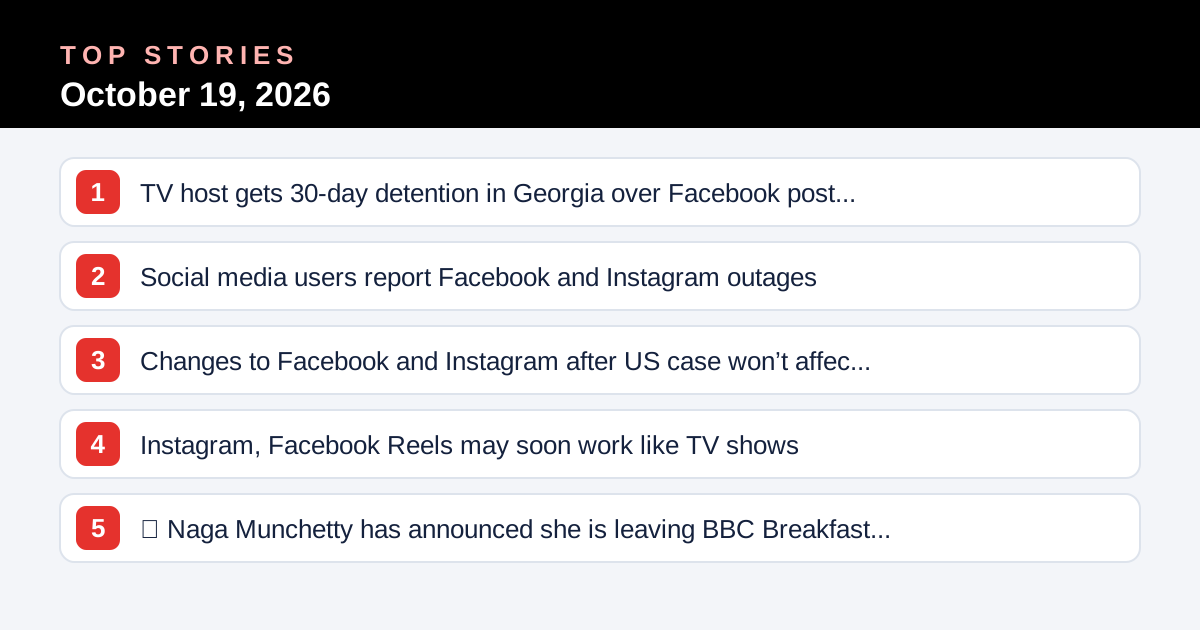
TV host gets 30-day detention in Georgia over Facebook post: reactions
Under the headline "TV host gets 30-day detention in Georgia over Facebook post: reactions", JAMnews covered this story on Oct 19, 2026. Interest in a story often grows when several outlets cover it at once, which makes it feel bigger than any single report. A good habit is to read past the first paragraph and look for named sources and clear dates. We include it here because it was widely reported, not because we have verified every detail.
Source: JAMnews, Oct 19, 2026
Social media users report Facebook and Instagram outages
On Sep 20, 2026, Stuff published a report headlined "Social media users report Facebook and Instagram outages". Stories that touch everyday life tend to be passed along fast, even when only a few details are known. A good habit is to read past the first paragraph and look for named sources and clear dates. We include it here because it was widely reported, not because we have verified every detail.
Source: Stuff, Sep 20, 2026
Changes to Facebook and Instagram after US case won’t affect Canada – yet
Under the headline "Changes to Facebook and Instagram after US case won’t affect Canada – yet", Cabin Radio covered this story on Aug 26, 2026. Stories that touch everyday life tend to be passed along fast, even when only a few details are known. If the story matters to you, compare it with a second outlet to see whether the main points match.
Source: Cabin Radio, Aug 26, 2026
Instagram, Facebook Reels may soon work like TV shows
On Jun 2, 2026, Gulf News published a report headlined "Instagram, Facebook Reels may soon work like TV shows". Headlines like this spread quickly because readers often share them before opening the full article. A good habit is to read past the first paragraph and look for named sources and clear dates.
Source: Gulf News, Jun 2, 2026
📺 Naga Munchetty has announced she is leaving BBC Breakfast after 17 years at the helm - and her broadcaster's new job has already been announced. It was confirmed on Tuesday (July 28) that she is swapping the famous red sofa for the BBC Radio 5 Liv
Under the headline "📺 Naga Munchetty has announced she is leaving BBC Breakfast after 17 years at the helm - and her broadcaster's new job has already been announced. It was confirmed on Tuesday (July 28) that she is swapping the famous red sofa for the BBC Radio 5 Liv", Facebook covered this story on Jul 28, 2026. A headline can only hold a fraction of a story, so the full report usually contains context that a headline leaves out. Before sharing, it helps to open the linked report and check who wrote it and when it was published.
Source: Facebook, Jul 28, 2026
Facebook acting up? Users in Malaysia and rest of the world report widespread outage, Meta yet to explain why
On Jul 19, 2026, Malay Mail published a report headlined "Facebook acting up? Users in Malaysia and rest of the world report widespread outage, Meta yet to explain why". Stories that touch everyday life tend to be passed along fast, even when only a few details are known. Before sharing, it helps to open the linked report and check who wrote it and when it was published. The full article is the place to find names, numbers, and quotes, none of which are repeated here.
Source: Malay Mail, Jul 19, 2026
Facebook suffers sudden outage, users report access issues
On Jul 19, 2026, Ammon News published a report headlined "Facebook suffers sudden outage, users report access issues". A headline can only hold a fraction of a story, so the full report usually contains context that a headline leaves out. Updates are common as new information arrives, so the original page may now say more than the headline did. This is one of the stories people have been talking about, and the source link below leads to the full report.
Source: Ammon News, Jul 19, 2026
RCMP begin investigation after hate posts in YK Facebook group
Cabin Radio ran this item on Jun 3, 2026 with the headline "RCMP begin investigation after hate posts in YK Facebook group". Short headlines are built to be understood at a glance, which is why they travel so well on social media. A good habit is to read past the first paragraph and look for named sources and clear dates.
Source: Cabin Radio, Jun 3, 2026
Police lodge report after fake statement linked to deputy IGP spreads on Facebook
On Aug 9, 2026, Malay Mail published a report headlined "Police lodge report after fake statement linked to deputy IGP spreads on Facebook". A headline can only hold a fraction of a story, so the full report usually contains context that a headline leaves out. Checking the publication date matters, because older stories sometimes resurface and look new. This is one of the stories people have been talking about, and the source link below leads to the full report.
Source: Malay Mail, Aug 9, 2026
Today, ABS-CBN Corporation marks its 80th founding anniversary. ❤️💚💙 The Kapamilya network traces its roots to June 13, 1946, with the establishment of Bolinao Electronics Corporation (BEC), which later became Alto Broadcasting System (ABS). Followin
On Jun 13, 2026, Facebook published a report headlined "Today, ABS-CBN Corporation marks its 80th founding anniversary. ❤️💚💙 The Kapamilya network traces its roots to June 13, 1946, with the establishment of Bolinao Electronics Corporation (BEC), which later became Alto Broadcasting System (ABS). Followin". Short headlines are built to be understood at a glance, which is why they travel so well on social media. Readers who want details should follow the link, because this summary does not replace the original reporting. We include it here because it was widely reported, not because we have verified every detail.
Source: Facebook, Jun 13, 2026
Facebook and Instagram users report widespread outage in New Zealand and overseas
Stuff reported this story on Jun 23, 2026 under the headline "Facebook and Instagram users report widespread outage in New Zealand and overseas". Interest in a story often grows when several outlets cover it at once, which makes it feel bigger than any single report. A good habit is to read past the first paragraph and look for named sources and clear dates.
Source: Stuff, Jun 23, 2026
How to Check a Headline Before You Share It
Start with the outlet. Is it a known publication with a named newsroom and a way to contact it? Then look at the date, the author, and the sources the article quotes. Read beyond the headline, because headlines are written to attract attention and can leave out important limits. If something sounds surprising, search for the same story on another outlet. When several independent reports agree on the main facts, that is a good sign. When only one obscure page carries it, wait before sharing.
Why Different Outlets Cover the Same Story Differently
Two outlets can report the same event and still emphasize different details. One may lead with the people involved, another with the numbers, a third with the reaction. These choices reflect audience, space, and editorial judgment. Reading more than one report is a practical way to see the full range of facts, and it makes it easier to notice when something is missing from a single account.
Why Numbers in Headlines Need Context
A number in a headline can sound precise while hiding important details. A figure may refer to a single place, a short period, or a particular definition that differs from what readers assume. Percentages can look large when the starting number is small, and totals can look small when spread across many people. The article itself usually explains what is being counted and how, which is why it is worth reading beyond the first line.
Why Context Matters More Than Speed
Being first to share a story is rarely as useful as being right. Context, such as what happened before, who is affected, and what is still unknown, is what turns a headline into understanding. Taking a few extra minutes to read the full report and a second source usually gives a far clearer picture than the first version that reaches your feed.
How to Follow a Story Over Several Days
Big stories usually take days to settle. Early reports are often incomplete, follow-up reports add context, and later articles may correct earlier details. If you want to stay informed without being swamped, pick one or two reliable sources, read their updates once or twice a day, and ignore reposts that add no new information. This keeps you informed without chasing every alert.
Opinion Pieces Versus News Reports
News reports aim to describe what happened, while opinion pieces argue for a point of view. Both can be valuable, but they should not be mixed up. Reputable outlets label opinion and analysis clearly. When a headline sounds more like a verdict than a description, check whether the article is an opinion column before treating its claims as settled facts.
Why Old Stories Sometimes Resurface
Older articles often return to feeds when someone shares them without the original date. Because pages can look new, readers may believe an old event just happened. Related news, anniversaries, or a new development can also push earlier reports back into view. Before reacting to a story, look for the date near the headline and compare it with other coverage. If the details seem familiar, the story may simply be a repeat.
Why Some News Stories Go Viral
News goes viral when it is easy to understand, easy to share, and connected to something people already care about. Strong emotions such as surprise, worry, or pride make readers more likely to pass a story along. Timing matters too: a story that lands during a busy news day may be overlooked, while the same story on a quiet day can dominate every feed. None of this says whether a story is accurate, which is why careful readers separate how popular a headline is from how reliable its details are.
Final Thoughts on These Facebook news broadcast Headlines
The headlines above show what many readers across the United States have been following. Each one links to the original report, which is where the facts, names, and quotes belong. Use this roundup as a quick guide, then read the sources that interest you. Notice how a story makes you feel, then check the facts. Small details often change the meaning of a headline. Try reading one story from two different outlets. Ask who benefits from a story spreading. Bookmark the stories you want to follow. Keep a list of sources you trust. Quality journalism depends on readers who value accuracy. Facts first. Verify before sharing.
This roundup is compiled automatically from the linked news reports. Details may be incomplete or change; please read the original sources.