Social health news: 13 Trending Headlines From Across the USA
What are Americans reading and sharing right now? This guide to viral social health news stories gathers real headlines from news outlets, credits every source by name, and explains how to read each one with a clear head. It is a starting point, not a replacement for the original reporting.
A note on how this page works: the headlines and outlet names below come directly from public news feeds. We do not add details that the reports do not state, and we do not claim to know more than the original journalists. When you want facts, names, numbers, or quotes, open the linked report.
Where These Headlines Come From
Headlines in this roundup come from public news feeds covering a wide range of outlets. Duplicates are removed, each item keeps its source name and publication date, and every headline is linked to the original article so nothing here depends on trust in this page alone.
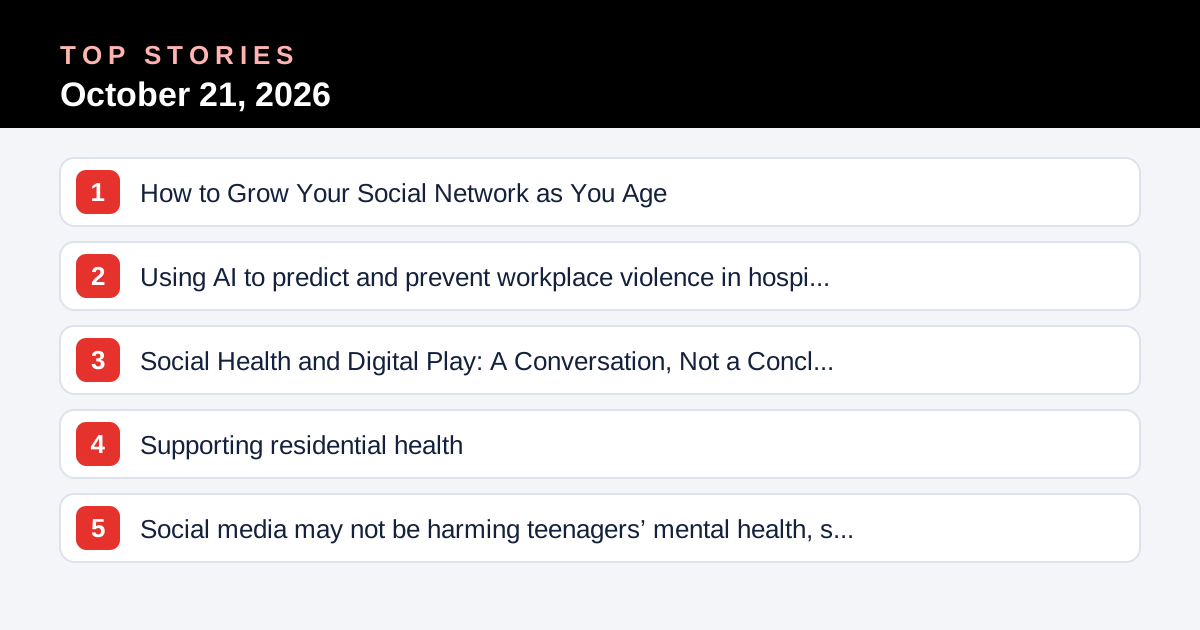
How to Grow Your Social Network as You Age
KFF Health News reported this story on Apr 23, 2026 under the headline "How to Grow Your Social Network as You Age". When a story trends, the first version many people see is a screenshot of the headline rather than the article itself. Updates are common as new information arrives, so the original page may now say more than the headline did.
Source: KFF Health News, Apr 23, 2026
Using AI to predict and prevent workplace violence in hospitals
MobiHealthNews reported this story on Feb 4, 2026 under the headline "Using AI to predict and prevent workplace violence in hospitals". Interest in a story often grows when several outlets cover it at once, which makes it feel bigger than any single report. If the story matters to you, compare it with a second outlet to see whether the main points match. This is one of the stories people have been talking about, and the source link below leads to the full report.
Source: MobiHealthNews, Feb 4, 2026
Social Health and Digital Play: A Conversation, Not a Conclusion
Under the headline "Social Health and Digital Play: A Conversation, Not a Conclusion", World Health Organization (WHO) covered this story on Jan 14, 2026. When a story trends, the first version many people see is a screenshot of the headline rather than the article itself. If the story matters to you, compare it with a second outlet to see whether the main points match.
Source: World Health Organization (WHO), Jan 14, 2026
Supporting residential health
The headline "Supporting residential health" appeared on Feb 25, 2026 from UC Irvine News. Headlines like this spread quickly because readers often share them before opening the full article. Updates are common as new information arrives, so the original page may now say more than the headline did. This is one of the stories people have been talking about, and the source link below leads to the full report.
Source: UC Irvine News, Feb 25, 2026
Social media may not be harming teenagers’ mental health, study finds
Under the headline "Social media may not be harming teenagers’ mental health, study finds", Euronews covered this story on Jan 16, 2026. Interest in a story often grows when several outlets cover it at once, which makes it feel bigger than any single report. Checking the publication date matters, because older stories sometimes resurface and look new. We include it here because it was widely reported, not because we have verified every detail.
Source: Euronews, Jan 16, 2026
Beyond weight loss: Examining the social effects of GLP-1 medications
ASU News reported this story on Jan 2, 2026 under the headline "Beyond weight loss: Examining the social effects of GLP-1 medications". A headline can only hold a fraction of a story, so the full report usually contains context that a headline leaves out. A good habit is to read past the first paragraph and look for named sources and clear dates.
Source: ASU News, Jan 2, 2026
Yes, alcohol is bad for you. But could it make us less lonely?
On Jan 24, 2026, NBC News published a report headlined "Yes, alcohol is bad for you. But could it make us less lonely?". A headline can only hold a fraction of a story, so the full report usually contains context that a headline leaves out. Checking the publication date matters, because older stories sometimes resurface and look new. We include it here because it was widely reported, not because we have verified every detail.
Source: NBC News, Jan 24, 2026
Young leaders call for urgent action to tackle social isolation and loneliness at the Global Model WHO 2025
World Health Organization (WHO) ran this item on Nov 1, 2025 with the headline "Young leaders call for urgent action to tackle social isolation and loneliness at the Global Model WHO 2025". Short headlines are built to be understood at a glance, which is why they travel so well on social media. If the story matters to you, compare it with a second outlet to see whether the main points match.
Source: World Health Organization (WHO), Nov 1, 2025
Social media time does not increase teenagers’ mental health problems – study
The headline "Social media time does not increase teenagers’ mental health problems – study" appeared on Jan 14, 2026 from The Guardian. When a story trends, the first version many people see is a screenshot of the headline rather than the article itself. Before sharing, it helps to open the linked report and check who wrote it and when it was published. The full article is the place to find names, numbers, and quotes, none of which are repeated here.
Source: The Guardian, Jan 14, 2026
Women's voices to be at the heart of renewed health strategy
GOV.UK ran this item on Apr 14, 2026 with the headline "Women's voices to be at the heart of renewed health strategy". Headlines like this spread quickly because readers often share them before opening the full article. Updates are common as new information arrives, so the original page may now say more than the headline did. This is one of the stories people have been talking about, and the source link below leads to the full report.
Source: GOV.UK, Apr 14, 2026
Heavy social media use and avoidance both linked to poorer wellbeing in teens
Under the headline "Heavy social media use and avoidance both linked to poorer wellbeing in teens", ABC News & Headlines – Australian Broadcasting Corporation covered this story on Jan 15, 2026. Headlines like this spread quickly because readers often share them before opening the full article. If the story matters to you, compare it with a second outlet to see whether the main points match. We include it here because it was widely reported, not because we have verified every detail.
Source: ABC News & Headlines – Australian Broadcasting Corporation, Jan 15, 2026
Community-Focused Projects that that tackle pressing social, health, and policy challenges across Ireland.
On Feb 24, 2026, Maynooth University published a report headlined "Community-Focused Projects that that tackle pressing social, health, and policy challenges across Ireland.". A headline can only hold a fraction of a story, so the full report usually contains context that a headline leaves out. A good habit is to read past the first paragraph and look for named sources and clear dates.
Source: Maynooth University, Feb 24, 2026
Soft drinks levy extended to protect children and improve health
GOV.UK reported this story on Nov 25, 2025 under the headline "Soft drinks levy extended to protect children and improve health". Stories that touch everyday life tend to be passed along fast, even when only a few details are known. A good habit is to read past the first paragraph and look for named sources and clear dates.
Source: GOV.UK, Nov 25, 2025
How Outlets Update Developing Stories
When events are still unfolding, reporters publish early versions and then update them as new facts arrive. That means a headline you saw this morning may have changed by the afternoon. Responsible outlets mark corrections and updates, usually near the top or bottom of the article. If you are following a developing story, check the original link again later instead of relying on a screenshot or a repost.
How Fact-Checkers Verify Viral Claims
Fact-checkers follow a simple routine. They find the original source of a claim, look for documents or recordings that support it, and ask whether the evidence matches what is being said. They also check dates and locations, because many viral posts mix real material with the wrong context. Readers can borrow the same habits: trace a claim back to where it started, look for primary sources such as official statements or court records, and be cautious when a post offers dramatic wording but no way to confirm it.
Why Old Stories Sometimes Resurface
Older articles often return to feeds when someone shares them without the original date. Because pages can look new, readers may believe an old event just happened. Related news, anniversaries, or a new development can also push earlier reports back into view. Before reacting to a story, look for the date near the headline and compare it with other coverage. If the details seem familiar, the story may simply be a repeat.
Why Numbers in Headlines Need Context
A number in a headline can sound precise while hiding important details. A figure may refer to a single place, a short period, or a particular definition that differs from what readers assume. Percentages can look large when the starting number is small, and totals can look small when spread across many people. The article itself usually explains what is being counted and how, which is why it is worth reading beyond the first line.
Spotting Misleading Images and Clips
Photos and short videos spread faster than text, and they are also easy to reuse out of context. An image that appears to show a current event may be older, from another place, or edited. Reverse image search tools and the original publisher's page can help confirm where a picture came from. If a striking image has no clear source, treat it with caution until a reliable outlet confirms it.
What a Trending Topic Does and Does Not Tell You
A trending label means many people are talking about something right now. It does not mean the topic is important, true, or new. Trends can be driven by a single post, a joke, or coordinated sharing. Use trends as a reason to look closer, then rely on the reporting itself, with named sources and clear dates, to understand what actually happened.
Building a Balanced News Routine
A steady routine beats constant checking. Choose a small set of outlets with different strengths, such as a national newspaper, a wire service, and a local source. Read them at set times instead of reacting to every alert. Add an occasional source from outside your usual preferences to see how other readers view the same events. A balanced routine keeps you informed while leaving room for the rest of your day.
Why Context Matters More Than Speed
Being first to share a story is rarely as useful as being right. Context, such as what happened before, who is affected, and what is still unknown, is what turns a headline into understanding. Taking a few extra minutes to read the full report and a second source usually gives a far clearer picture than the first version that reaches your feed.
The Bottom Line on Today's Viral Social health news Stories
The headlines above show what many readers across the United States have been following. Each one links to the original report, which is where the facts, names, and quotes belong. Use this roundup as a quick guide, then read the sources that interest you. Read to understand, not just to react. Thanks for reading.
This roundup is compiled automatically from the linked news reports. Details may be incomplete or change; please read the original sources.